

Local Clean Energy Projects & Incentives
Incentives for the Change our Ocean Needs
Central Coast Energy Projects
The climate crisis is an ocean crisis, but you have the power to help turn the tide. At Surfrider SLO, we believe that real change happens when local passion meets organized action. Here is how you can help protect the Central Coast today.
Floating Offshore Wind
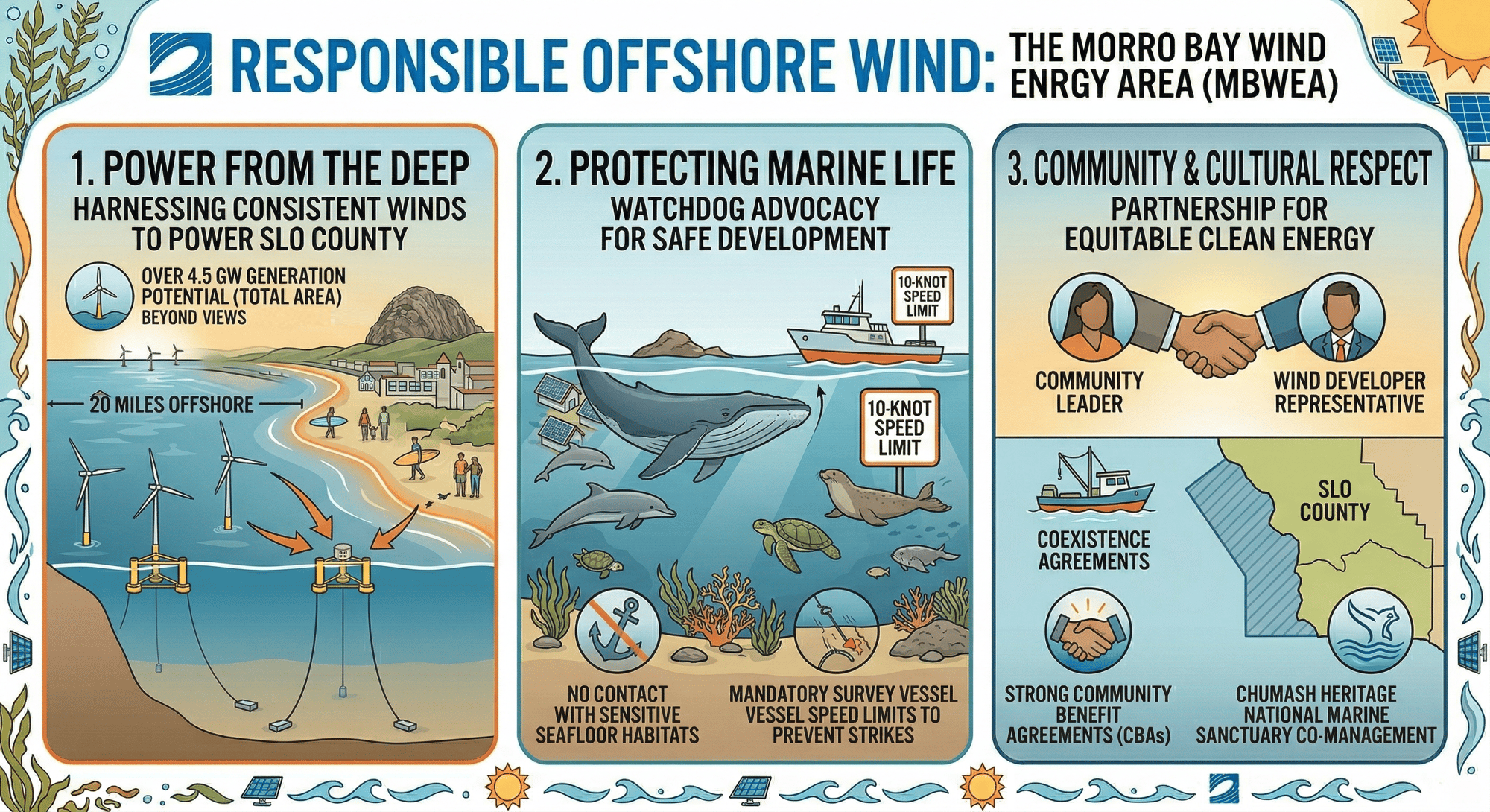
- Description: Utility-scale wind turbines mounted on floating platforms anchored 20 miles offshore in the Morro Bay Wind Energy Area.
- Benefits: Potential to generate over 4.5 gigawatts of renewable energy, helping California meet its goal of 100% carbon-free electricity by 2045.
- Status: 373,268 acres leased (Morro Bay Wind Energy Area). Commercial operations delayed until 2036.
- Environmental & Ecological Concerns:
- Benthic & Habitat: Potential impacts on seafloor features (corals/rock outcroppings) from anchors and cables.
- Marine Mammals: Risk of vessel strikes and noise disruption during site characterization.
- Recreational: Alteration of wave energy and industrialization of scenic coastal vistas.
- Mitigation Pathways:
- Mandatory Conditions: 10-knot speed limits for survey vessels and strict prohibition of contact with sensitive seafloor habitats.
- Community Oversight: Coordination with the proposed Chumash Heritage National Marine Sanctuary and Community Benefit Agreements (CBAs) for local fishing communities.
Utility-Scale Solar Infrastructure
- Description: Massive arrays of photovoltaic panels located in the county's inland plains, such as the Carrizo Plain.
- Benefits: Delivers large-scale, zero-emission electricity to the state grid, contributing significantly to Senate Bill 100 targets.
- Status: Major facilities include Topaz (586 MW) and CA Valley Solar Ranch (250 MW).
- Environmental & Ecological Concerns:
- Habitat Fragmentation: Large-scale land conversion in sensitive inland plains and grasslands.
- Biodiversity: Disruption of local flora and fauna corridors.
- Mitigation Pathways:
- Prioritization: Shifting policy focus toward distributed, rooftop-mounted solar to reduce the need for large land-use projects.
- Siting: Utilizing low-impact areas and existing municipal footprints (e.g., airports, county centers).
Rooftop Solar
- Description: Customer-sited photovoltaic (PV) systems installed on existing residential rooftops. Unlike utility-scale solar, these "behind-the-meter" systems generate power at the point of consumption, reducing the need for long-distance transmission lines and protecting natural landscapes.
- Benefits: Rooftop and small-scale solar currently provide approximately 10% of California’s total energy demand (over 19 GW installed). However, the state’s technical potential is immense; utilizing all viable residential and commercial roof space could meet up to 74% of California’s annual electricity needs.
- The NEM 3.0 Shift: In April 2023, California transitioned to Net Energy Metering 3.0 (NEM 3.0), which fundamentally changed the economics of rooftop solar. Under this new policy, the value of excess energy "sold" back to the grid was slashed by roughly 75%, significantly extending the payback period for solar-only systems and making the addition of battery storage nearly essential for financial viability.
- Environmental & Ecological Concerns: Minimal. This is the "gold standard" for low-impact energy.
- Siting: Uses entirely pre-developed surfaces. By maximizing rooftop solar, we reduce the pressure to build industrial-scale "solar deserts" that can displace sensitive coastal and inland habitats.
- Surfrider’s Position: STRONG SUPPORT. We advocate for policy reforms that make rooftop solar affordable for all Californians. Protecting our coasts means fighting for an energy grid that prioritizes distributed resources over massive, land-intensive infrastructure projects.
Micro Solar (SB 868) “Balcony Solar”
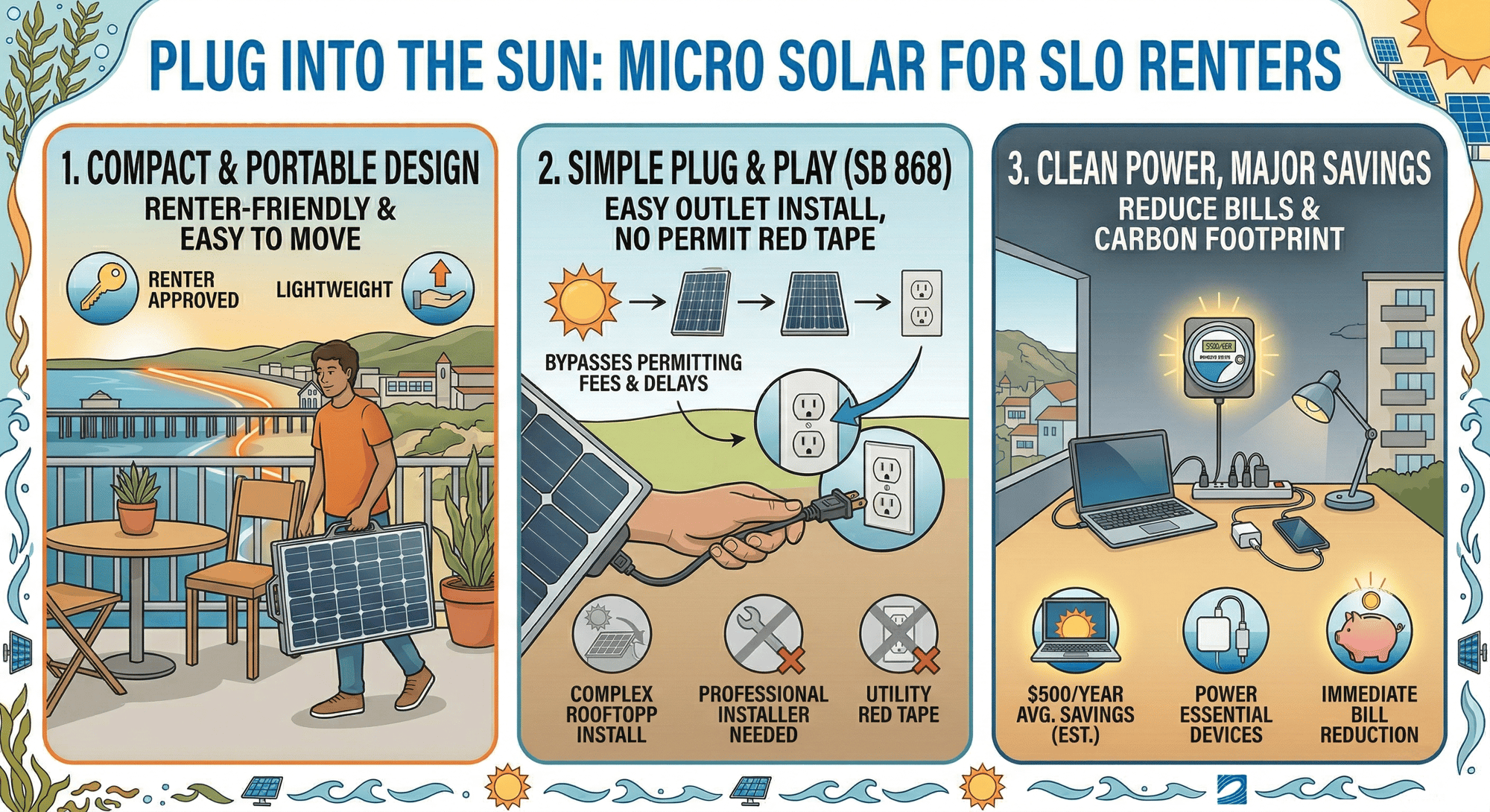
- Description: Small, portable photovoltaic (PV) systems (typically 400W–1,200W) designed for residential use. These "plug-and-play" units connect directly into standard 120V wall outlets, functioning like a common household appliance rather than a permanent utility installation.
- Benefits: Dramatically increases access to clean energy for renters and apartment dwellers. These systems reduce monthly electricity bills by up to $500/year, lower the carbon footprint of individual households, and remain fully portable for users who move.
- Status: California Senate Bill 868, known as the "Plug Into the Sun Act," is currently moving through the state legislature. It aims to reclassify these systems as appliances to remove utility "red tape," prohibitive permitting fees, and interconnection delays.
- Environmental & Ecological Concerns: Minimal to Zero. Unlike large-scale installations, micro solar utilizes the existing "gray" footprint of built environments.
- Siting: Uses existing residential surfaces such as balcony railings, patios, and fences. This avoids the land-use conflicts and habitat fragmentation often associated with large inland solar farms.
- Surfrider’s Position: STRONG SUPPORT. Surfrider advocates for decentralized, community-based renewable energy. This "bottom-up" transition empowers individuals to participate in the clean energy economy while protecting our coastal and inland open spaces from industrial-scale development.
Battery Energy Storage Systems (BESS)
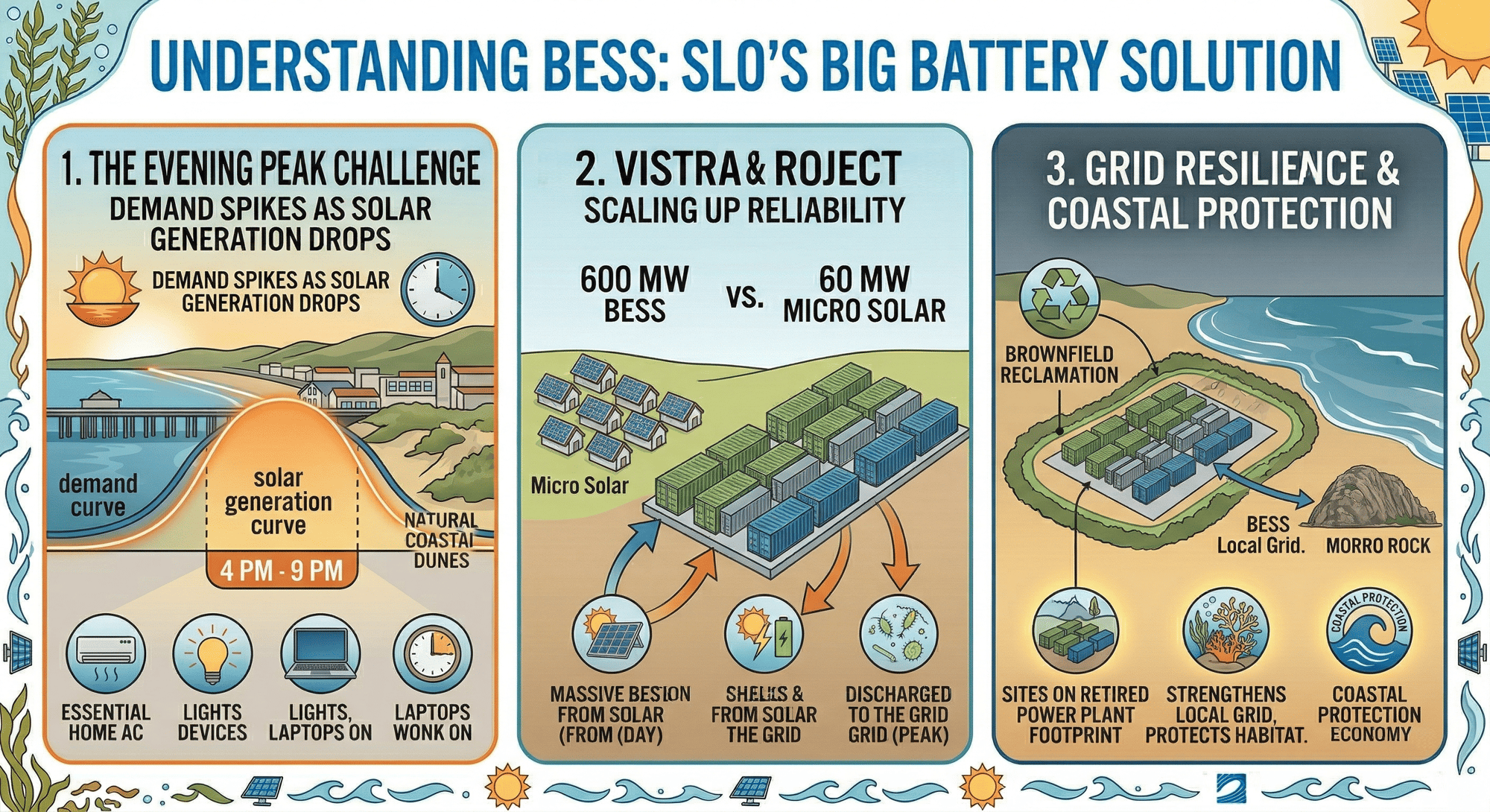
- Description: Large-scale lithium-ion battery facilities designed to store renewable energy for use during peak demand hours.
- Benefits: Captures excess solar/wind energy during the day to prevent grid overloads and provides power between 4 PM and 9 PM when solar production drops.
- Status: 600 MW Vistra project proposed at the retired Morro Bay Power Plant site.
- Environmental & Ecological Concerns:
- Thermal Runaway: Potential for battery fires releasing toxic gases (carbon monoxide, methane).
- Water Quality: Fire-fighting runoff potentially carrying contaminants into local watersheds.
- Mitigation Pathways:
- Brownfield Prioritization: Utilizing previously industrial "brownfield" sites to avoid disturbing undeveloped coastal lands.
- Safety Engineering: Emergency response plans specifically designed to contain runoff and protect water quality.
Diablo Canyon Power Plant (DCPP)
- Description: A nuclear power facility located near Avila Beach. It is California's largest power plant and its most significant carbon-free energy asset.
- Benefits: Provides approximately 9% of California's total electricity and 17% of its carbon-free generation
- Status: Operational extension approved through 2029 (Unit 1) and 2030 (Unit 2). 20-year renewal under NRC review.
- Environmental & Ecological Concerns:
- Marine Impact: Once-through cooling (OTC) systems impinge and entrain marine life.
- Public Safety: Seismic risks from nearby Hosgri/Shoreline faults; potential reactor vessel embrittlement in Unit 1.
- Waste: Long-term storage of radioactive waste in a coastal zone vulnerable to sea-level rise.
- Mitigation Pathways:
- Restorative Mitigation: Permanent conservation of 12,000 acres of "Diablo Canyon Lands" and dedication of 25 miles of new public trails.
- Safety Mandates: Physical embrittlement testing required in 2025; comprehensive seismic reviews required for operations beyond 2030.
- Waste Management: Advocacy for swift transfer to dry cask storage and eventual relocation to a stable, consent-based repository.
Santa Maria Phillips 66 Refinery Decommissioning
- Description: The dismantling and environmental cleanup of the legacy Phillips 66 petroleum refinery in Arroyo Grande.
- Benefits: Removes a major source of industrial pollution and carbon emissions, allowing for the ecological restoration of the site.
- Status: Demolition and remediation of the Phillips 66 facility (Arroyo Grande) is currently active.
- Environmental & Ecological Concerns:
- Legacy Pollution: Long-term subsurface contamination from decades of petroleum processing.
- Mitigation Pathways:
- Rigorous Remediation: Continuous monitoring of the demolition phase and site-neutralization efforts as outlined in the 2024 Final Environmental Impact Report (EIR).
Clean Energy Incentives
Transitioning to a clean energy future is a collective effort, and both state and federal programs offer significant financial support to help our community lead the way. Whether you are a homeowner, a renter, or a small business owner, these incentives make it more affordable to invest in the technologies, like rooftop solar, battery storage, and electric vehicles, that protect our local coastline from the impacts of fossil fuel use. Use the guide below to explore the tax credits and rebates available to San Luis Obispo residents, but be mindful of upcoming legislative deadlines that may affect your eligibility.
Federal Clean Energy Incentives (OBBBA 2025)
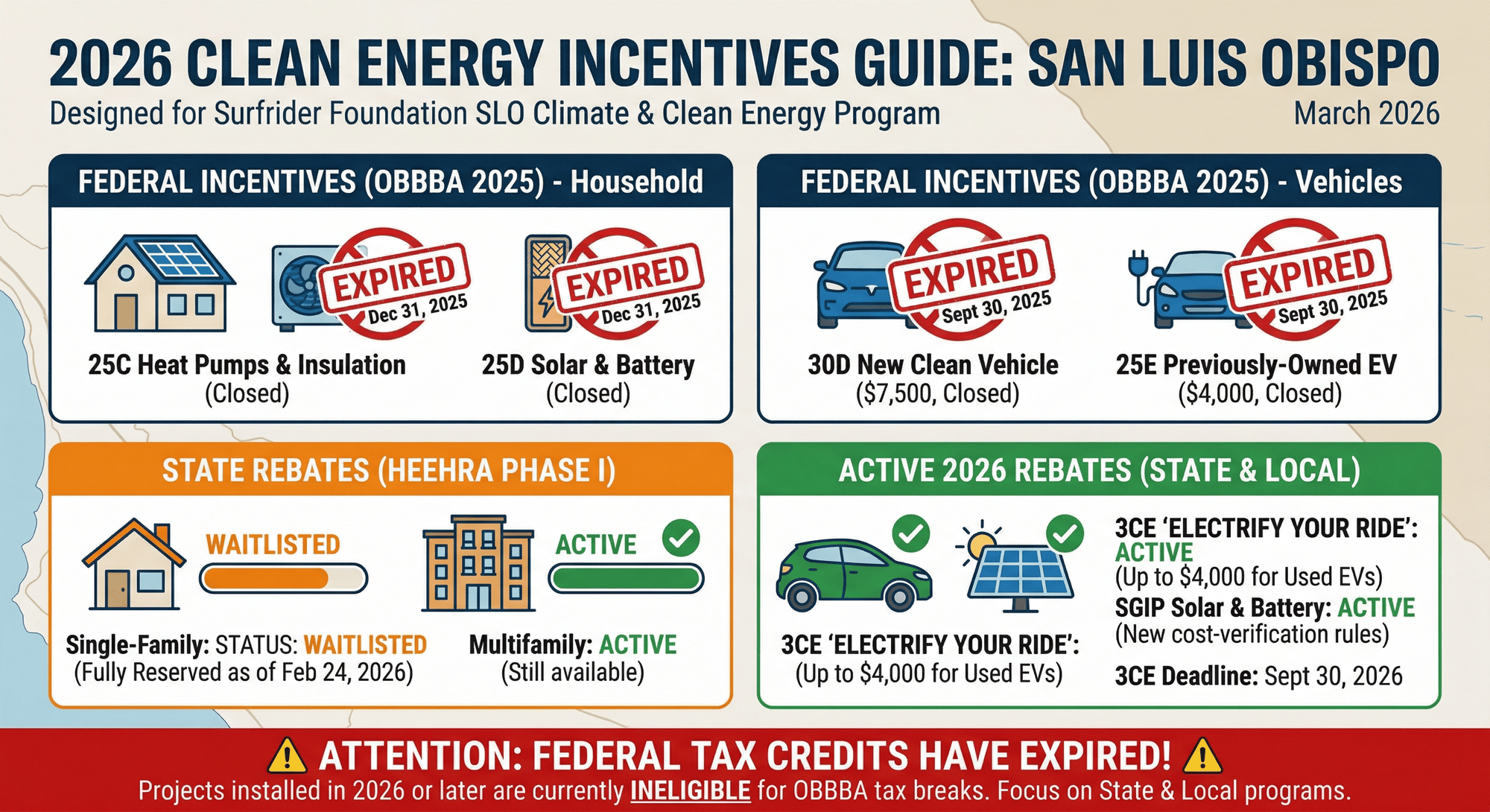
Important: The One Big Beautiful Bill Act (OBBBA) introduced hard deadlines for many federal credits.
|
Incentive |
Eligibility Deadline |
Current Rate |
|
Residential Clean Energy (25D) |
Dec 31, 2025 |
30% (Solar, Battery, Wind) |
|
Energy Efficient Home (25C) |
Dec 31, 2025 |
Varies (Heat Pumps, Insulation) |
|
New Clean Vehicle (30D) |
Sept 30, 2025 |
Up to $7,500 |
|
Previously-Owned EV (25E) |
Sept 30, 2025 |
Up to $4,000 |
Note: Projects installed in 2026 or later are currently ineligible for these federal tax breaks under current law.
State & Regional Incentives (2026)
Central Coast Community Energy (3CE)
- Electrify Your Ride: Rebates up to $4,000 for new EVs and $2,800 for used EVs (income-dependent). Applications for 2026 purchases must be submitted by Sept 30, 2026.
- Residential Battery Rebate: $300–$500 per kWh for systems 5–26 kWh. Requires daily discharge during peak hours.
Self-Generation Incentive Program (SGIP)
- General Market: Covers approx. 15% of battery costs.
- Equity Resiliency: Covers 80%–100% of costs for low-income or medically vulnerable residents.
3C-REN (Tri-County Regional Energy Network)
- Single-Family: $750–$1,500 incentives for heat pump HVAC, water heaters, and insulation.
- Multifamily: Base rebates of $1,000 per unit, up to $5,000 with specific upgrades.
California Energy Commission (HEEHRA/TECH)
- HEEHRA Phase I: Up to $8,000 (single-family) or $14,000 (multifamily) for electrification.
- Requirement: Systems installed after Jan 1, 2026, must use refrigerants with GWP of 700 or lower.
Local Sustainability Initiatives
- City of SLO: Targeting carbon neutrality by 2035. New buildings must be all-electric or meet enhanced efficiency standards.
- SLO Green Business Program: Managed by ECOSLO. Offers $250 reusable rebates and free energy advising for small businesses.
Fossil Fuels on the Coast
While we look toward a future of "generation," we must acknowledge the "era of extraction" that shaped the Central Coast. For over a century, our shores were the front lines of global oil shipping and production—often at a devastating cost to our beaches, dunes, and communities.
A Timeline of Impact
The Central Coast has served as both a global hub and a victim of fossil fuel reliance. Understanding our history explains why our chapter is so dedicated to a clean energy future.
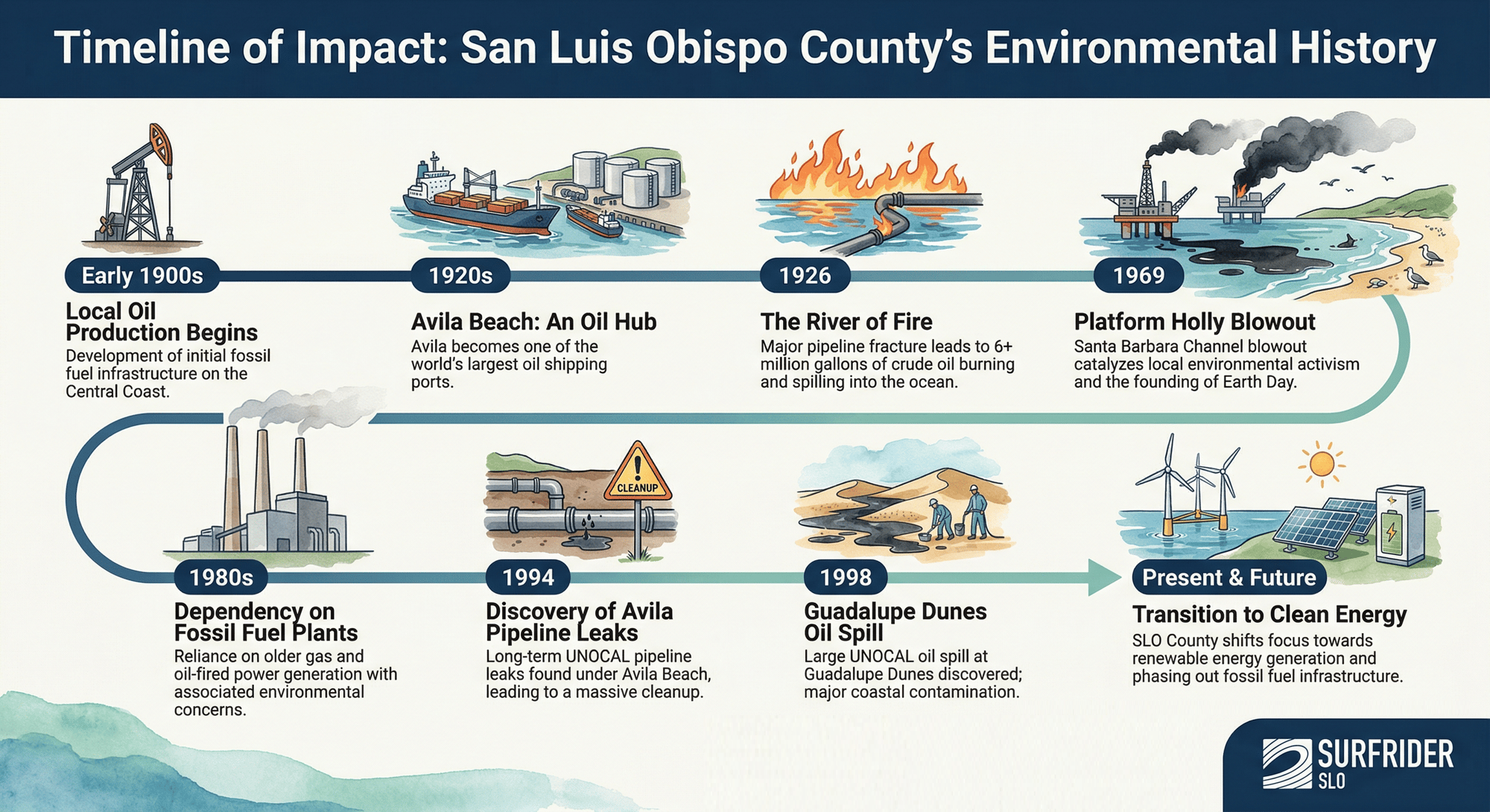
- 1920s: The Oil Capital – Avila Beach was once the largest capacity oil shipping port in the world.
- 1926: The River of Fire – A lightning strike at the Tank Farm Road facility ignited 6 million gallons of crude oil. It flowed down San Luis Obispo Creek into Avila Bay in a "river of fire". Remediation and clean-up efforts at this site continue to the present day.
- 1969: The Great Blowout – The Platform Holly spill in the Santa Barbara Channel released an estimated 100,000 barrels. Tar balls polluted the San Luis Obispo County coast, marking the largest spill in California waters at the time.
- 1980s: Guadalupe Dunes Disaster – Decades of chronic leaks released an estimated 12 million gallons of diluent into the Guadalupe-Nipomo Dunes and the Pacific—the largest oil spill in the history of the continental U.S..
- 1990s: Avila’s Underground Plume – A 400,000-gallon plume of petroleum was discovered beneath downtown Avila Beach. Cleaning it required demolishing much of the downtown area and excavating 200,000 tons of soil by 2000.
The Economic Shift: Billions vs. Cents
The true cost of fossil fuels isn't found at the pump; it’s found in the staggering price of cleaning up after them.
- The Price of Pollution: Historical remediation for local disasters like the Avila and Guadalupe spills has cost hundreds of millions of dollars. Modern spills, such as the 2015 Refugio incident, carry overall expenses (including legal claims) estimated near $257 million.
- The Power of Progress: In contrast, the 2025 Lazard LCOE+ report highlights that utility-scale solar and onshore wind remain the most cost-competitive forms of new-build energy generation, even without tax subsidies.
- A Smart Investment: While the cost of building new gas-fired generation has reached a 10-year high due to supply shortages and rising commodity prices, renewable energy continues to be the lowest-cost and quickest-to-deploy resource available for our community.
Status Update: The Price Canyon Footprint
Our work isn't just about historical spills; it's about the active extraction happening in our backyard at the Arroyo Grande Oil Field in Price Canyon.
- Active vs. Idle: As of early 2026, the Arroyo Grande field remains one of the most carbon-polluting oilfields in the state. While over 800 wells have been drilled in the county since 1977, many older wells remain "idle" or abandoned, dating back to the early 1900s.
- Ongoing Expansion: Despite the 2015 permit expiration, regulators have authorized dozens of new wells under "replacement" labels, with additional permits for new drilling in California already being approved at record rates in January 2026.
- Restoration Efforts: There is a growing movement to permanently plug and abandon idle wells. For example, a 2026 plan was finalized to remove and restore the habitat of 11 idle wells in the nearby Carrizo Plain National Monument.
A Community That Fights Back
Our history is defined not just by spills, but by organized resistance. SLO County has been a pioneer in coastal protection policy:
- Measure A (1986): A landmark citizen-led initiative that requires voter approval for any onshore support facilities for offshore oil and gas. It remains the law of the County today.
- The Oil Train Victory (2017): Surfrider SLO, alongside an environmental coalition, successfully defeated the Phillips 66 "Oil Train" project. This victory prevented mile-long tankers of Alberta tar sands from rolling through our "blast zone" near homes, schools, and businesses.
"This is a proud day for the thousands of Californians who stood up and said 'No' to its proposed crude oil train." - Charles Varni, Surfrider Foundation Slo Chair